
‘Pretty in Pink’ Flower Arrangement
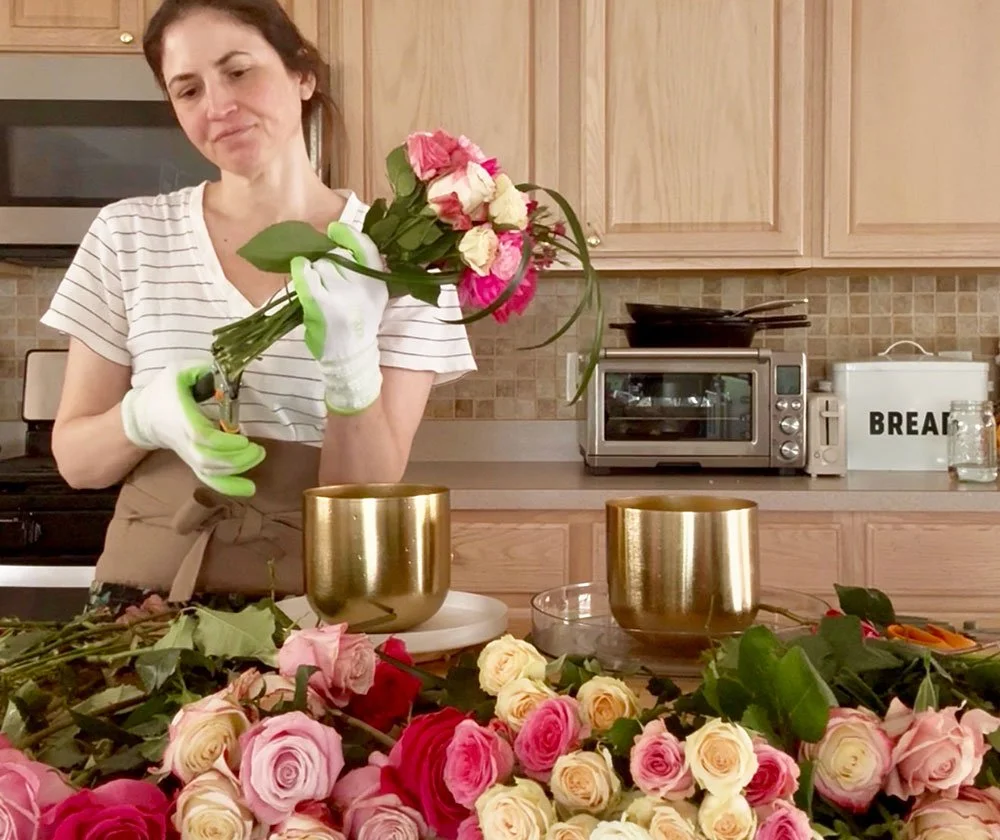
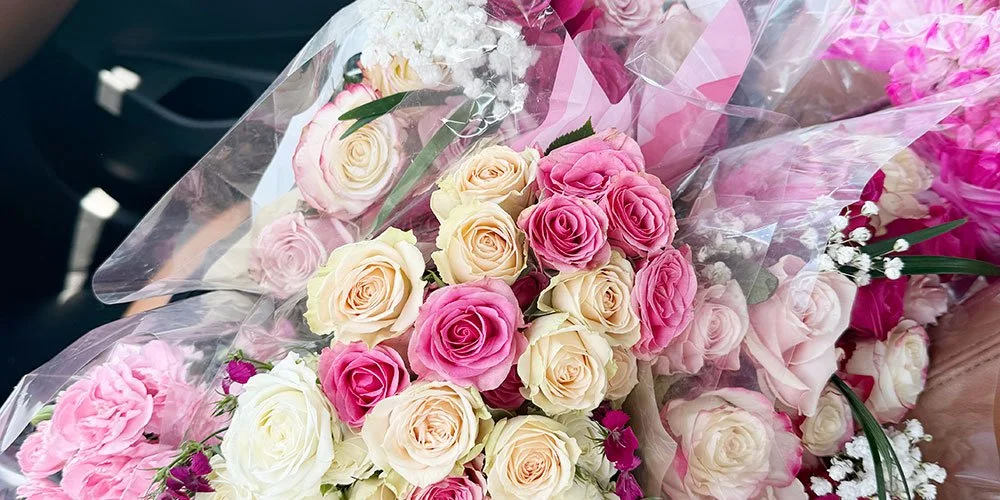
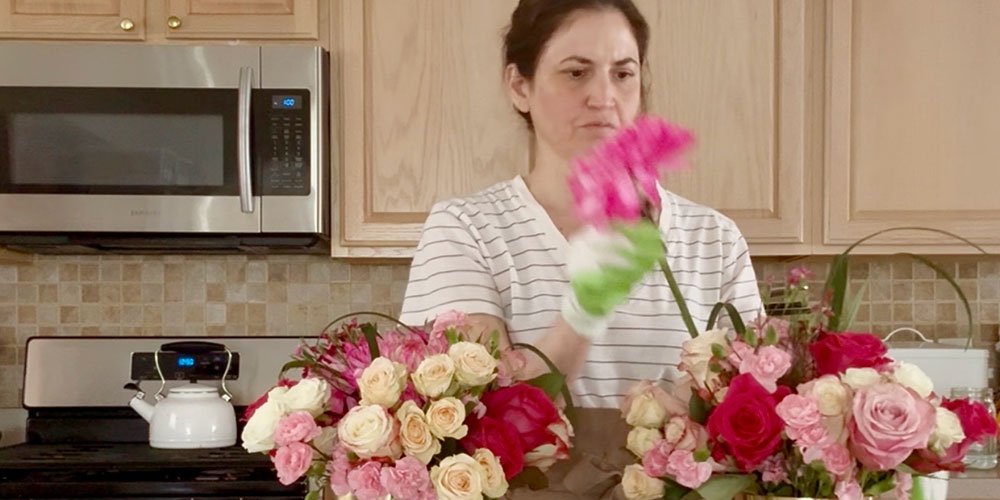
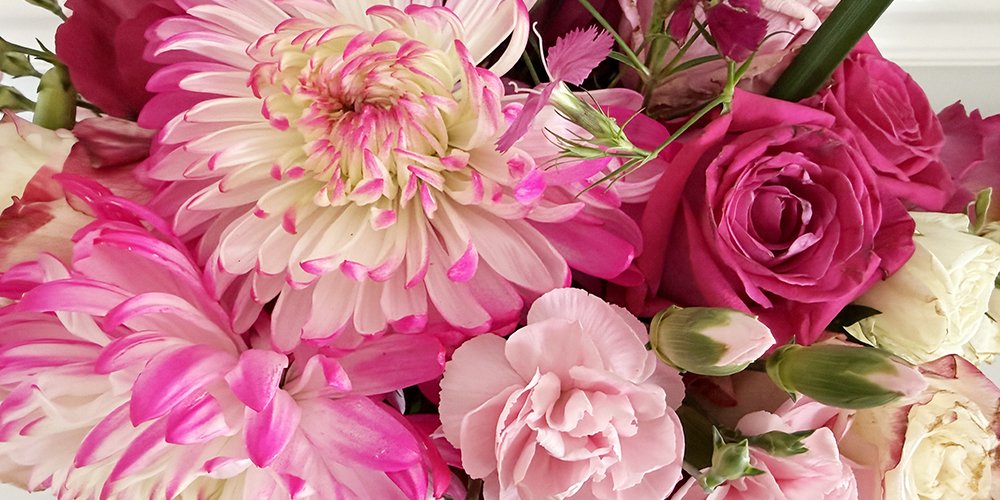
There is something about bringing a bucket of flowers home that immediately changes the energy of a room.
I have always loved arranging flowers, but I don't necessarily approach it like a florist. I choose flowers because I love their color, shape, texture, or simply because something about them catches my eye. Then I bring them home and begin playing.
This arrangement is a perfect example.
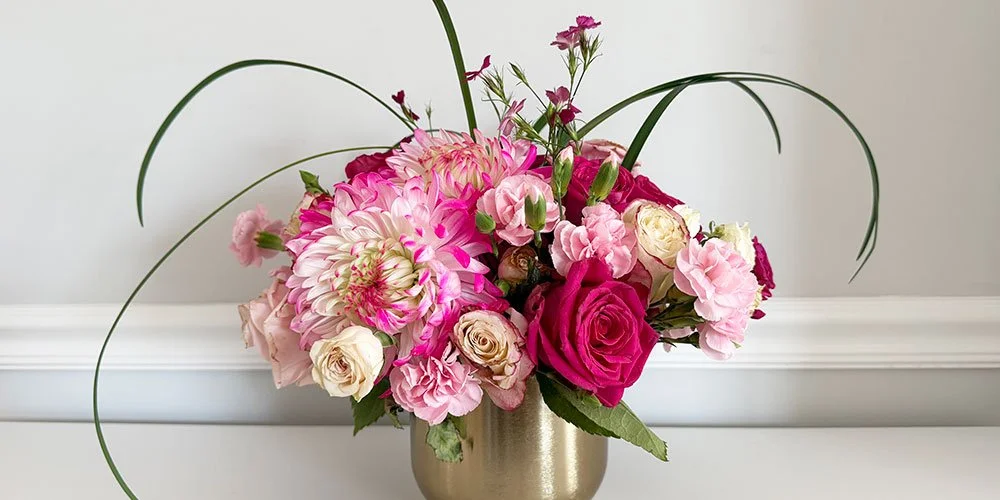
I knew I wanted something abundant and romantic, with lots of shades of pink mixed with creamy whites. I wanted the arrangement to feel lush, but not too formal, so I added long, curving pieces of bear grass that would reach out from the flowers and give the arrangement a little movement and whimsy.
Interestingly, I didn't know the names of all of the flowers I had used when I made it. Part of the fun of looking back at an arrangement is learning what those flowers actually are.
Here is what went into this one.
The Flowers
Hot Pink Roses
The deep pink roses are some of the focal flowers in the arrangement.
Roses have such a classic shape that they can easily become the obvious star of a bouquet, but I like using them alongside flowers with very different shapes. Here, the roses provide those beautiful, defined centers while the other flowers soften everything around them.
The hot pink also gives the arrangement a little energy against all of the softer blush and cream tones.
Cream Garden Roses
The small cream-colored roses are some of my favorites in this arrangement.
Garden roses have that wonderfully full, almost ruffled appearance, with layers upon layers of petals. They feel romantic without being overly formal, and the creamy color helps soften the intensity of the hot pink.
They also add another type of rose shape to the arrangement, which keeps the bouquet from feeling repetitive.
Pink Chrysanthemums
The large pale pink and white flowers with many narrow petals are chrysanthemums, or mums.
These are wonderful flowers for adding volume. Unlike roses, which have a defined, compact shape, chrysanthemums have a more open, almost starburst-like appearance.
I especially love how the pink centers and white outer petals pick up the colors of the other flowers around them.
They make the arrangement feel a little more playful.
Pink Carnations
There are also several pale pink carnations tucked throughout the bouquet.
Carnations sometimes get overlooked, but I think they are wonderful in an arrangement. Their ruffled petals add texture, and they are especially pretty when mixed with flowers that have smoother or more structured petals.
Here, they help bridge the different flowers together.
Lisianthus
The delicate pink flowers and buds scattered throughout the arrangement appear to be lisianthus.
Lisianthus has a lovely, slightly romantic quality. The flowers resemble small roses, but their stems and petals give them a much lighter, airier appearance.
I love using flowers like this because they fill the spaces between the larger focal flowers without making the arrangement feel crowded.
Scabiosa
The tiny magenta flowers on long, delicate stems toward the top of the arrangement appear to be scabiosa.
These are exactly the kind of flowers I love for adding a little unexpected movement.
They are small, but because they sit higher than the main body of the arrangement, they draw the eye upward and keep the bouquet from becoming one solid mass of flowers.
Bear Grass
And then there is the bear grass.
This might actually be my favorite part of the arrangement.
The long, thin blades curve dramatically outward from the flowers, creating those wonderful sweeping lines. Instead of simply filling space, the greenery becomes part of the design.
Some pieces arch over the flowers while others curve almost all the way down toward the vase.
It gives the arrangement movement.
Without it, the bouquet would feel much more traditional. With it, it feels a little wild.
The Color Palette
For this arrangement, I stayed within a fairly simple palette:
Hot pink + blush pink + soft pink + cream + white + green
I think this is one of the easiest ways to create an arrangement that feels cohesive.
You don't necessarily need to buy all of the same flower or even flowers that look similar. Instead, try choosing a color palette and then finding flowers in different shapes and textures within those colors.
That's what makes an arrangement interesting.
You might have one large flower, one round flower, something ruffled, something delicate, and something that reaches outward.
The flowers don't have to match.
They just need to belong together.
How I Created the Arrangement
I don't usually begin with a rigid plan.
I start by looking at the flowers I have and deciding which ones feel like the focal points.
For this arrangement, the roses and large chrysanthemums became the visual anchors.
I placed those throughout the arrangement rather than putting all of the large flowers in the center. I wanted the eye to move around the bouquet.
Then I began filling in the spaces with the smaller flowers—the carnations, lisianthus, and other delicate blooms.
1. Start with your focal flowers
Choose two or three of your largest or most visually important flowers.
Place them at slightly different heights rather than creating one perfectly symmetrical center.
2. Add flowers with a different shape
This is where flowers like chrysanthemums and carnations come in.
Look for contrast.
If you have a very round flower, add something ruffled. If you have something tightly layered, add something more open and airy.
3. Fill the spaces
Use your smaller flowers and buds to fill in the gaps.
Don't try to make every space completely full. A little breathing room allows the individual flowers to be seen.
4. Add movement
This is where I added the bear grass.
Instead of trimming everything to the same height, let a few pieces extend beyond the main shape of the arrangement.
This is one of my favorite little tricks for making a grocery-store or farmers-market bouquet feel more artistic.
5. Step back
This might be the most important part.
Put the arrangement down.
Walk away.
Then come back and look at it from across the room.
You will often see something you couldn't see while standing directly over it.
Maybe one side feels too heavy. Maybe a flower needs to be moved. Maybe you need one more piece of greenery.
Arranging flowers is a little bit like creating a painting. Sometimes you have to stop working on it in order to actually see it.
Let the Arrangement Be Imperfect
One of the things I love most about arranging flowers at home is that there is no need for perfection.
In fact, I think flowers are more beautiful when they aren't perfectly arranged.
Let one stem lean.
Let one flower sit a little higher.
Let the greenery wander.
Let the arrangement have a little asymmetry.
Flowers are organic. They grow in different directions, have different shapes, and open at different times. Trying to force every stem into exactly the right position can take away some of their natural beauty.
Instead, I try to work with what the flowers want to do.
Flower Arranging as Flower Therapy
This is why I have started thinking of my flower arranging as a kind of flower therapy.
There is something very calming about the process.
You have to slow down.
You have to pay attention.
You touch the flowers, smell them, look closely at their colors and textures, trim their stems, change the water, and decide where each one belongs.
For a little while, there is nothing else to do.
No phone.
No list.
No productivity goal.
Just flowers.
And then, when you are finished, you get to live with the result.
A vase of flowers sitting on the table can become a small reminder to notice beauty in the middle of an ordinary day.
You Don't Need to Be a Florist
I think sometimes we make creative activities more intimidating than they need to be.
You don't need to know the names of every flower.
You don't need a professional floral frog or a collection of expensive tools.
You don't need to know the rules of floral design.
Start with flowers you love.
Choose a few colors that make you happy.
Put them in a vase.
Move them around until you like what you see.
That's it.
And if you don't know what a flower is, look it up afterward. That's exactly what I did with this arrangement—and now I know a little more about the flowers I was instinctively drawn to.
Maybe that's part of the joy, too.
We don't have to know everything before we begin.
Sometimes we can simply begin with something beautiful and learn as we go.
My Flower Recipe
If you'd like to create something similar to this arrangement, here is the basic flower recipe:
Hot pink roses
Cream garden roses
Pink chrysanthemums
Pink carnations
Pink lisianthus
Scabiosa or another delicate flowering filler
Bear grass
A few pieces of additional greenery, if desired
Don't worry about finding the exact varieties or quantities.
The idea is to combine different flower shapes, different textures, and different heights, while keeping the color palette cohesive.
And most importantly, choose flowers that make you happy.
Because that's really what flower therapy is about.
Not creating the perfect arrangement.
Just taking a little time to create something beautiful.